
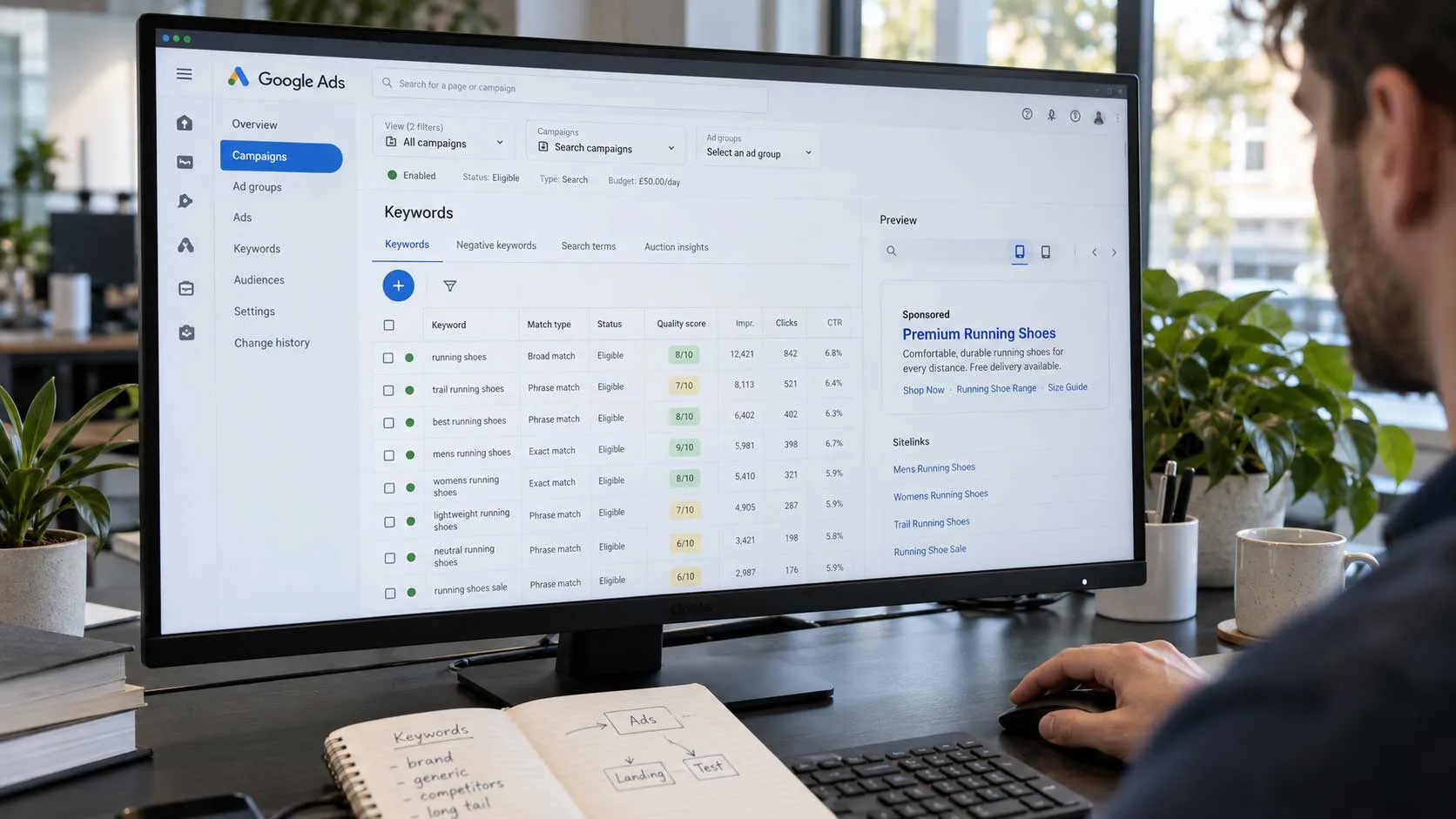
Quality Score in Google Ads
If a keyword reads "Eligible (limited)" with the note "Rarely shown due to low quality score", Google is telling you the score is low and that this is keeping the ad from appearing often. The score is diagnostic: it is not used directly in the auction, but it summarises three things that genuinely affect your cost and your volume. This article covers how to read it and which of the three to check first.
In short
- Quality Score is a diagnostic and is not used directly in the ad auction. The work goes into the three components: expected clickthrough rate, ad relevance and landing page experience.
- Changing match type does not change the score - it is calculated from the history of exact searches for your keyword. With general keywords, check how well the ad and the page answer the searcher's intent.
- Beyond the score, the auction itself is influenced by device, location, time of day and ad assets, and assets are excluded from expected clickthrough rate.
Table of contents
- What Quality Score is and is not
- The three components and how to read them
- What "Rarely shown due to low quality score" means
- What a low score costs you
- What our own data shows
- The landing page
- Ad relevance
- Expected clickthrough rate
- Why general keywords perform worse
- The order of work on a low score
- When a keyword is not worth it
- What makes no difference
- Frequently asked questions
What Quality Score is and is not
Quality Score is a 1 to 10 rating at keyword level, comparing the quality of your ads with that of other advertisers on the same query. Google describes it as a diagnostic tool and states explicitly that it is not used directly in the auction.
What that means in practice
The system does not take the number 7 and multiply something by it. In the real auction, more granular signals are evaluated at the moment of each search, and Google notes that some factors related to ad quality are not reflected in the reported score at all: device, location, time of day and ad assets. The score is a summary, not a mechanism.
It matters nonetheless, because it summarises real problems. A keyword scoring 2 usually has at least one component below average, and that shows up in cost and in impression volume. The work goes into the components, not the number.
Where to find it
Add the Quality Score column and the three component columns to your keyword table. Without them you see only the final score, which does not tell you what to fix. If a keyword shows only a dash, it has not yet gathered enough impressions: draw no conclusions from an empty cell.
The three components and how to read them
Each component gets one of three values: above average, average, below average. According to Google's Quality Score documentation, these are what show you where improvement is worthwhile.
| Component | What it measures | Who controls it |
|---|---|---|
| Expected clickthrough rate | How likely the ad is to be clicked for that query | Partly you, partly the competition |
| Ad relevance | How close the ad copy is to the intent behind the query | Entirely you |
| Landing page experience | How useful and relevant the page is where the person arrives | Entirely you |
Where to start
Not by template: start with the lowest-rated component among the keywords that actually spend. Google notes that an "average" rating is also an opportunity to improve, not only "below average" - so three average components do not mean there is nothing to do, only that the gap to the competition is smaller. When more than one is below average, the landing page is usually cheaper to fix than building up clickthrough history.
The typical combination
The pattern we see most often: ad relevance average, expected clickthrough rate average, landing page experience below average. The root is usually the same - the ad promises something specific and the page is generic.
What "Rarely shown due to low quality score" means
The "Eligible (limited)" status with that note means the keyword's Quality Score is very low and this is preventing the ad from showing often. That is different from, and more serious than, a low score on its own.
The difference
- A low score without a limitation: the ad shows, but more expensively and less often than a competing ad with the same bid.
- A limited keyword: the ad takes part in considerably fewer auctions, even though budget is available.
How to spot it
The status column reads "Eligible (limited)", and hovering reveals the specific reason. The limitation can come from several different factors, not only quality, so read the note itself. If it points to quality, the problem is relevance, not budget and not bidding.
Why it is easy to miss
Because the campaign keeps spending. The money goes to the other keywords in the same group, and the limited one simply brings no volume. You see normal spend and assume everything is working.
What a low score costs you
A more expensive click for the same position
At an equal bid, the advertiser with a more relevant ad and a better page usually pays less for the same placement. The Quality Score number itself does not take part in the auction directly, but the signals it summarises are evaluated at every search.
Fewer impressions
You lose some auctions. You see low volume, and the first reaction is usually to raise the bid. That works up to a point, but you are paying to work around a problem you could have fixed.
Worse enquiries, for a different reason
This is not a consequence of the score itself, but of the mismatch the score reflects. When the page does not answer the query, the person who clicked goes back. Those who do not go back sometimes leave an enquiry that is off-topic. You pay for the click and then for the time spent on an unsuitable enquiry. The low score is the signal, not the cause.
What our own data shows
The figures below are from our own account for the Bulgarian market, in the SEO services niche, accumulated over the campaign's full run. These are recorded conversions: which actions sit behind that figure determines what the percentage means, so always check the conversion action list in your own account before comparing.
| Metric | Value |
|---|---|
| Clicks | 1938 |
| Impressions | 26,564 |
| Clickthrough rate | 7.30% |
| Average cost per click | €0.72 |
| Recorded conversion rate from clicks | 1.93% |
| Cost per recorded conversion | €37.13 |
How the keywords compare
The best-performing keyword in the account is "website optimisation" in Bulgarian: 400 clicks, 3.25% recorded conversions, €22.40 per conversion. The highest-volume one is "seo optimisation": 720 clicks, 1.94%, €38.92. So the narrower phrasing produces a recorded conversion at close to half the cost.
That is an observation from one account, not an industry rule. The difference may also come from the ad, the landing page or the period, not only the keyword: there is no test here isolating each factor.
What the price-intent queries show
The keywords with price intent in the account produced 28 clicks and no recorded conversions. This needs reading carefully: at an average 1.93%, 28 clicks correspond to roughly 0.54 expected conversions. Zero out of 28 is no surprise and proves nothing about what those searchers want. The sample is far too small for a conclusion. What it does show is that there is not yet enough data on those queries to decide anything.
How to plan a budget around differences like these is covered in the article on the Google Ads budget.
The landing page
Landing page experience is the component we find below average most often, and the reason is usually the same: the ad points to the wrong place.
What Google assesses
- Whether the page contains what the ad promises.
- Whether the expected information is visible without hunting around.
- Whether the page loads reasonably, especially on mobile.
- Whether it is clear what happens next: how to enquire, who you deal with.
- Whether navigation is passable.
The costliest mistakes
- Every ad points at the home page. The home page answers everything in general and nothing in particular.
- The ad targets a narrow query while the page is generic. Someone who searched "seo audit for an online store" lands on a page about SEO in general.
- The page gives no price indication and does not say what the price depends on.
What to do
For every ad group, designate one page that answers exactly the queries in it. If no such page exists, creating it matters more than rewriting the ad. What holds a visitor and leads to action is covered in the article on the effective business website.
A quick check: open the landing page on a phone and ask yourself the question from the query. If you cannot find the answer within the first two screens, the visitor probably will not either. That is a check for people - it is not a criterion Google uses to assess the page.
Ad relevance
Relevance measures how close your copy is to the intent behind the query. This is the component that is fixed fastest.
What works
- The words from the query appear in the headline, naturally rather than stuffed.
- The ad answers the question rather than describing the company.
- The group holds a small number of closely related queries.
- There is specificity: timeframe, scope, what is and is not included.
- The promise in the ad is visible on the page as well.
Why groups with many keywords perform badly
Because one headline cannot be close to twenty different intents. A group of five related queries allows an ad that speaks to them precisely. The rule is old, but nothing in the automation of recent years has retired it.
What not to write
Do not promise first position, do not promise timeframes you cannot meet, and do not put a price in the ad that does not exist on the page. A mismatch between ad and page hits both components at once.
Expected clickthrough rate
This is a forecast of how likely your ad is to be clicked for that query, relative to other advertisers. Part of it depends on you, part does not.
You control the headline, the match to the query and how far the offer stands out. You do not control the strength of the brands competing on the same query, or how often users find answers directly in the search results: on general informational queries, clickthrough rate falls for everyone.
There is an important exception here that is often understood backwards. Ad assets do not feed into this component: Google states that their influence is removed from the determination of expected clickthrough rate and that you should not expect an improved Quality Score from adding them. Assets are factored into Ad Rank and can bring more clicks - that benefit simply will not appear in the score.
This component is the slowest to improve, because it is a forecast based on history. Even after a good change, the score is recalculated once the keyword accumulates new impressions, and at low volumes that takes weeks.
Why general keywords perform worse
One clarification that often gets skipped. Match type is not the cause. Google calculates Quality Score from the history of exact searches for your keyword and states that changing match type does not affect the score. Broadening the match only helps the keyword take part in more auctions and so accumulate data.
What to check with general keywords
A short, non-specific search term covers mixed intent: someone searching only "seo services" may want a definition, prices, a list of firms, a job or a comparison. One ad struggles to answer all of those at once, so with such keywords look first at ad relevance and landing page experience. The score is determined through the three components - that is where you see what is wrong, and the length of the phrase is not by itself an explanation.
What usually works better
| Instead of | Better | Why |
|---|---|---|
| seo services | seo for an online store | The intent is clear, the ad can be precise |
| seo price | monthly seo retainer cost | The searcher has already decided on the format |
| website | website for a small business | All the informational searching drops away |
When a short keyword still makes sense
When the budget is sufficient and there is a dedicated page built for it, covering the several possible intents. On a small budget, short general keywords spend disproportionately and usually stay on low scores. Moving to a more specific phrase is a change of target, not a trick for lifting the number.
The order of work on a low score
- Add the three component columns. Without them you are working blind.
- Sort keywords by spend and look at scores only for the ones that spend. A keyword scoring 2 on two clicks is not a priority.
- See which component is below average. That determines what you fix, not a general rule.
- If it is the page: change the landing page or expand it.
- If it is the ad: rewrite it to echo the words from the query and promise exactly what the page delivers.
- Split groups holding many unrelated keywords.
- Wait for new data before touching the same thing again.
What gets fixed immediately
The waiting applies to judging the effect, not to everything. A broken form, irrelevant searches in the report and an ad pointing at the wrong page get fixed the moment you see them. There is no point gathering data on something you already know is wrong.
How long it takes
Ad relevance is reassessed fastest. Landing page experience follows a crawl of the new version. Expected clickthrough rate needs accumulation. The timeframe depends on volume: weeks on an active campaign, considerably longer at a few impressions a day.
And do not change bidding, budget and strategy in the same week you touch pages and ads: you will not be able to connect the change to the result.
When a keyword is not worth it
Not every low score gets fixed, and some keywords are better dropped.
The signs
- Two consecutive rounds of fixes with no movement in the components.
- The query brings clicks but no recorded conversions over a long enough period and at sufficient volume.
- Those searching it clearly want something you do not sell.
- Cost per recorded conversion is several times the account average with no explanation.
- The quality limitation persists despite a new landing page.
What to put in its place
The search terms report shows the words people actually use to reach your ad. Three or four narrower phrasings with better enquiries are usually hiding in there. The same report is also the best source of content topics, which is covered in the article on how Google Ads and SEO work together.
When the problem is not the advertising
If cost per recorded conversion is acceptable but the enquiries do not become customers, Quality Score has nothing to do with it. The work there is on the path from enquiry to contract. The overall framing of the paid channels is on the online advertising page, and campaign-level settings on the Google Ads page.
What makes no difference
Changing match type
This is the most common wasted move. The score is calculated from exact searches and does not change with the match type. Change the keyword's phrasing, not its setting.
Raising the bid
It buys impressions but improves none of the three components. It works as a temporary measure and is expensive as a permanent one.
More keywords in the group
Adding further variants does not raise relevance, it dilutes it. The direction is the opposite.
A new campaign from scratch
It starts with no history and the same pages. If the problem is the landing page, it carries over intact.
Chasing a ten
A score of 10 is not the goal. A keyword scoring 7 that brings recorded conversions at an acceptable cost is better than a 9 bringing none.
Frequently asked questions
Why does a keyword score 1 when it is getting clicks?
Because the score compares your combination of ad and page with those of other advertisers on the same query, not whether you are getting clicks. You can be getting clicks and still be below average, paying more for them. Look at the three components: at a score of 1, at least two are usually below average, most often ad relevance and landing page experience.
Will the score improve if I change the match type?
No. Google calculates Quality Score from the history of exact searches for the keyword and states that changing match type does not affect the score. A broader match only helps the keyword take part in more auctions and so gather enough data to be scored. If the components are weak, work on the ad and the page, and where intent is unclear consider a more specific phrase. A more specific phrase does not guarantee a higher score - the goal is a suitable search and a useful ad, not a better number.
How long after a change does a new score appear?
It depends on impression volume for that keyword: the score is recalculated once there is enough new data. On an active campaign that means weeks, at a few impressions a day considerably longer. During that period do not touch the same thing twice, or you cannot connect the change to the result. Obvious defects, such as a broken form or a wrong landing page, get fixed immediately.
 Back
Back


